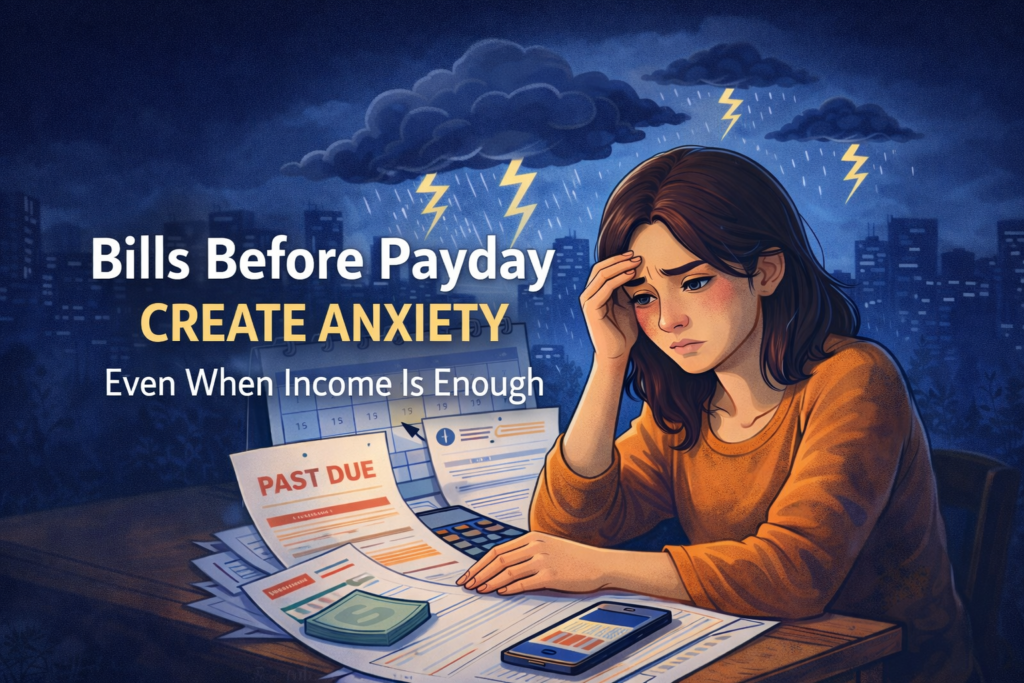
There’s a quiet pressure that shows up every time you think about your money. You tell yourself you’ll sit down “later” to review everything. You imagine spreadsheets, numbers, decisions, and maybe even disappointment. The longer you delay it, the heavier it feels. And when you finally open your banking app, what was supposed to be a simple weekly money check turns into a 45-minute spiral of overthinking.
It rarely starts with a problem. Bills aren’t late. Income hasn’t disappeared. Nothing dramatic has happened. But the act of checking feels loaded. You scroll through transactions twice. You re-calculate upcoming payments. You open three tabs. Instead of feeling calmer, your chest tightens. What should have brought reassurance somehow creates more anxiety.
If this sounds familiar, it’s not because you lack discipline. It’s because no one ever explained how long a weekly money check should actually take — or why letting it stretch too long quietly increases stress instead of reducing it. The length of your weekly money check matters more than most people realize.
If reviewing your money sometimes leaves you feeling worse instead of better, that does not mean you are bad with finances. It often means the system you’re using asks too much of you at once.
By the end of this article, you’ll know the ideal length for a weekly money check, why shorter builds calm, and how to structure it so you leave feeling reassured instead of drained.
Why Logic and Income Alone Don’t Fix This
Many people assume that if they earn enough and budget carefully, checking their money should feel simple. But emotional regulation and financial awareness are not the same thing. Even with stable income, your brain reacts to uncertainty more than to math. When you sit down for a weekly money check without a time boundary, your mind starts scanning for threats instead of clarity.
The brain prefers quick closure. Long, open-ended review sessions signal that something is wrong or unresolved. That subtle signal increases cortisol, which is the same stress response triggered when facing an actual financial emergency. Ironically, the longer you stretch your weekly money check, the more your nervous system interprets it as danger — even if your numbers are fine.
Financial stress in America is rarely about math alone. According to the American Psychological Association’s Stress in America report, money consistently ranks as a top stressor for adults. And data from the Federal Reserve’s Survey of Household Economics and Decisionmaking shows many households experience financial strain even when meeting obligations. The issue often lies in uncertainty and timing — not irresponsibility.
U.S. Money Insight
Research from both the Federal Reserve and the American Psychological Association shows that unpredictability drives financial anxiety more than income level alone. Short, structured reviews reduce uncertainty without overwhelming your decision-making capacity.
The Ideal Length: 10–15 Minutes
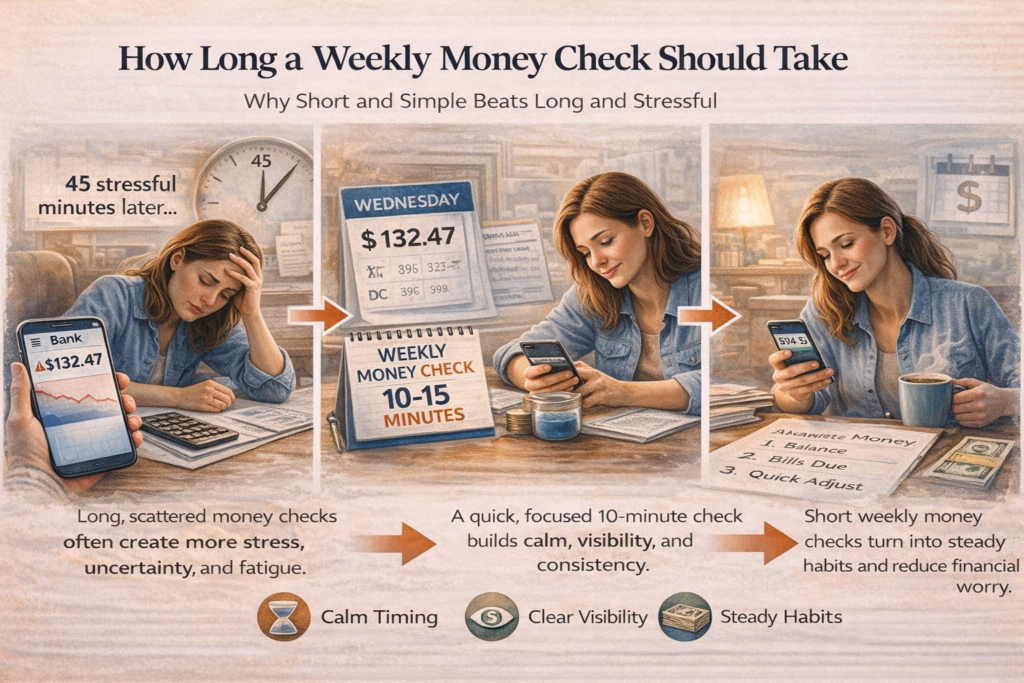
A weekly money check should take 10 to 15 minutes. Not 45. Not an hour. Not a full financial deep dive. Its purpose is awareness, not analysis. Its goal is reassurance, not optimization. When you limit your weekly money check to 10–15 minutes, you create psychological safety because your brain knows there is an endpoint.
Within those minutes, you only need to answer three questions: What is my current balance? What bills are due before the next paycheck? Do I need to adjust anything small this week? That’s it. No retirement projections. No long-term forecasting. No reworking every category.
Keeping your weekly money check short protects it from becoming emotionally overwhelming. When it stays short, you’re more likely to repeat it. And repetition builds calm.
Cash-Flow Timing Insight
Most U.S. workers are paid biweekly or semimonthly, while expenses hit at irregular intervals. This timing gap can temporarily lower your checking balance midweek even when income is sufficient. A short weekly money check helps you navigate those dips without escalating stress.
When Stress Peaks During the Week
Money stress often spikes midweek — especially on Wednesdays — when weekend spending becomes visible and the next paycheck feels distant. This pattern is explored in Why Fridays Feel Safe and Wednesdays Feel Dangerous Financially. The emotional dip isn’t random. It’s tied to timing visibility.
If your weekly money check happens during that window and runs too long, you amplify that stress. A contained 10-minute review keeps you informed without letting that emotional wave grow.
Why Traditional Budgeting Fails Emotionally
Traditional budgeting often turns every review into a correction session. Categories are adjusted. Spending is judged. Projections are reworked. That level of depth has value — but not every week. If your weekly money check becomes a mini monthly overhaul, your brain associates it with criticism instead of reassurance.
This is one reason people skip reviews altogether, as discussed in Why Skipping Your Weekly Money Check Makes Money Feel Scarier Than It Is. When the process feels heavy, avoidance feels safer. A shorter structure removes that barrier.
Buffers, Visibility, and Reassurance
The power of a weekly money check increases dramatically when paired with a checking cushion. Even a modest buffer softens what you see on your screen. If you’re unsure how much to keep available for real-life calm, Money to Keep in Checking Account for Real Life Calm explains it clearly.
Visibility plus cushion equals reassurance. Without visibility, uncertainty grows. Without a cushion, visibility feels sharp. Together, they make your weekly money check stabilizing instead of stressful.
The Avoidance Loop
When a weekly money check stretches into a long emotional session, many people delay the next one. The longer they wait, the more uncertainty builds. Eventually, checking feels intimidating. That cycle often shows up after overspending weeks, which is explored in What Happens When You Do a Weekly Money Check After a Bad Spending Week?.
A predictable 10-minute boundary breaks that loop. You are not diving into everything. You are staying aware in a contained way.
Maria used to spend nearly an hour every Sunday reviewing her accounts. She double-checked transactions, moved money repeatedly, and recalculated totals several times. By the end, she felt drained. When she shortened her weekly money check to 12 minutes using a simple checklist, something shifted. She stopped dreading it. She confirmed her balance, reviewed upcoming bills, adjusted one small category, and closed the app. The calm came from consistency, not intensity.
Weekly Reassurance vs. Monthly Planning
Monthly planning has a different purpose. That is when you evaluate goals, adjust savings rates, and redesign categories. A weekly money check is maintenance. It keeps you oriented without overwhelming you.
Think of it like checking your fuel gauge versus rebuilding the engine. One requires minutes. The other requires strategy and time. Mixing the two is what makes many weekly reviews feel heavy.
If you want this process to feel simple and repeatable, the SavoirSprout Weekly Money Check System gives you a structured 10-minute template designed specifically for calm visibility. It walks you through balance awareness, upcoming bill timing, and one intentional adjustment — without turning the session into a full budget overhaul. It’s built to support consistency, not perfection.
Frequently Asked Questions
Is 10 minutes really enough for a weekly money check?
Yes. The purpose is awareness and reassurance. You are confirming direction, not rebuilding your entire financial plan.
What if I discover a problem during my weekly money check?
Make a note and schedule a separate planning session. Avoid extending the weekly review beyond its boundary unless it’s urgent.
Should I check more than once per week?
For most people, once per week creates enough visibility. More frequent checking can increase anxiety unless there is a short-term reason.
Quick Reflection
- Do I allow my weekly money check to stretch longer than needed?
- How do I typically feel after reviewing my accounts?
- What might change if I stopped at 12 minutes consistently?
Final Thoughts
A weekly money check is meant to calm your nervous system, not challenge it. When you keep your weekly money check to 10–15 minutes, you transform it into a stabilizing habit instead of a draining event. The boundary creates safety. The repetition builds trust. And over time, that short, consistent weekly money check becomes one of the simplest ways to feel steady and in control of your money again.