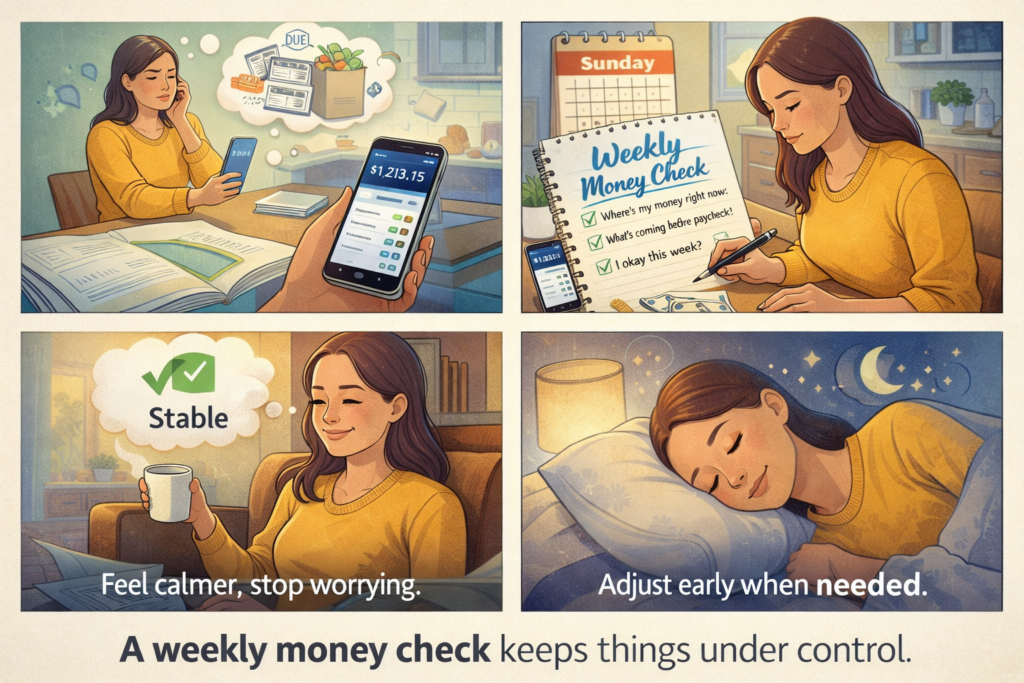
Weekly money check is not about budgeting perfectly, tracking every dollar, or becoming “good with money.” It is about creating one calm moment each week where you stop guessing and start knowing. For many Americans, money stress does not come from lack of income. It comes from uncertainty. It comes from not knowing if things are okay right now.
You open your banking app. You see a number. Your chest tightens. You are not sure what that number actually means for your life. Can you relax? Should you worry? Is this fine or is this dangerous? A weekly money check answers those questions without drama.
If money often feels tight even when you earn enough, this deeper explanation of why money feels tight breaks down how timing and uncertainty—not income—create stress.
Why money stress feels constant even when you earn enough
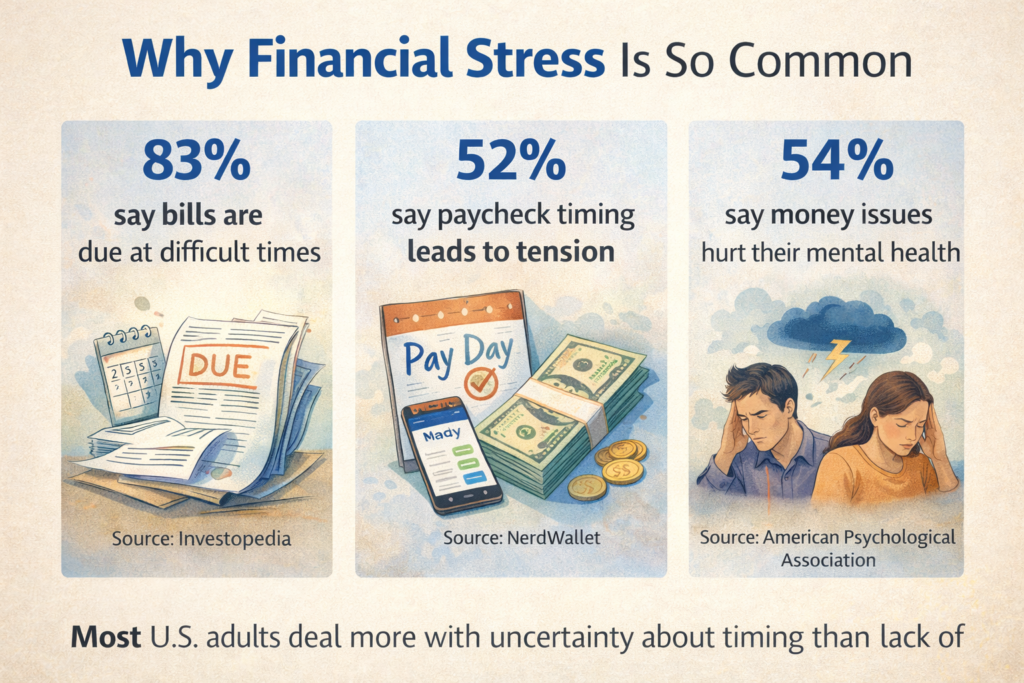
Most people think money stress comes from low income. But that is not what most working adults experience. Money stress comes from timing, mental load, and lack of clarity. Bills do not arrive evenly. Paychecks do not line up with expenses. Life does not respect budgets.
When you do not have a weekly money check, your brain tries to do the job instead. It tracks balances in the background. It replays upcoming bills at night. It runs “what if” scenarios while you are at work, driving, or trying to relax. This is exhausting.
A weekly money check moves that mental work out of your head and into a short, contained moment. Instead of thinking about money every day, you think about it once a week, on purpose.
Quick check-in: What usually causes your money stress?
You’re not alone. Most money stress comes from uncertainty, not failure.
What a weekly money check actually is
A weekly money check is not a budget. It is not expense tracking. It is not a financial makeover. It is a short weekly pause where you answer three basic questions:
Where is my money right now?
What is coming before I get paid again?
Am I okay this week or do I need to adjust?
That is it.
The power of a weekly money check is not complexity. It is containment. Money stops leaking into every part of your life because it has a scheduled place to be handled.
Why monthly budgeting fails real people
Monthly budgets look clean on paper. Real life is not clean. A bill on the 3rd and a paycheck on the 15th creates stress even if the month “works.” A surprise expense breaks a perfect plan. A bad week emotionally leads to overspending that a budget never predicted.
A weekly money check works because life happens weekly, not monthly. Groceries, gas, school expenses, work lunches, and small emergencies show up every week. Checking weekly keeps you grounded in reality instead of ideal plans.
This is also why traditional budgeting breaks down between paydays. Instead of guessing, many people benefit from understanding budgeting between paychecks, which focuses on cash flow timing rather than rigid monthly rules.
This is why financial educators increasingly recommend short-cycle reviews instead of long-term projections. Sites like NerdWallet and Investopedia consistently emphasize cash flow awareness over rigid rules.
Weekly money check and the feeling of safety
Safety is not about having a lot of money. Safety is about knowing where you stand. A weekly money check gives you that knowledge in a repeatable way.
When you know you are okay this week, your nervous system relaxes. You stop checking your balance five times a day. You stop hesitating over every small purchase. You stop carrying money anxiety into unrelated parts of your life.
When you know you are not okay this week, you can act early instead of panicking late. Early adjustments are small. Late adjustments feel like emergencies.
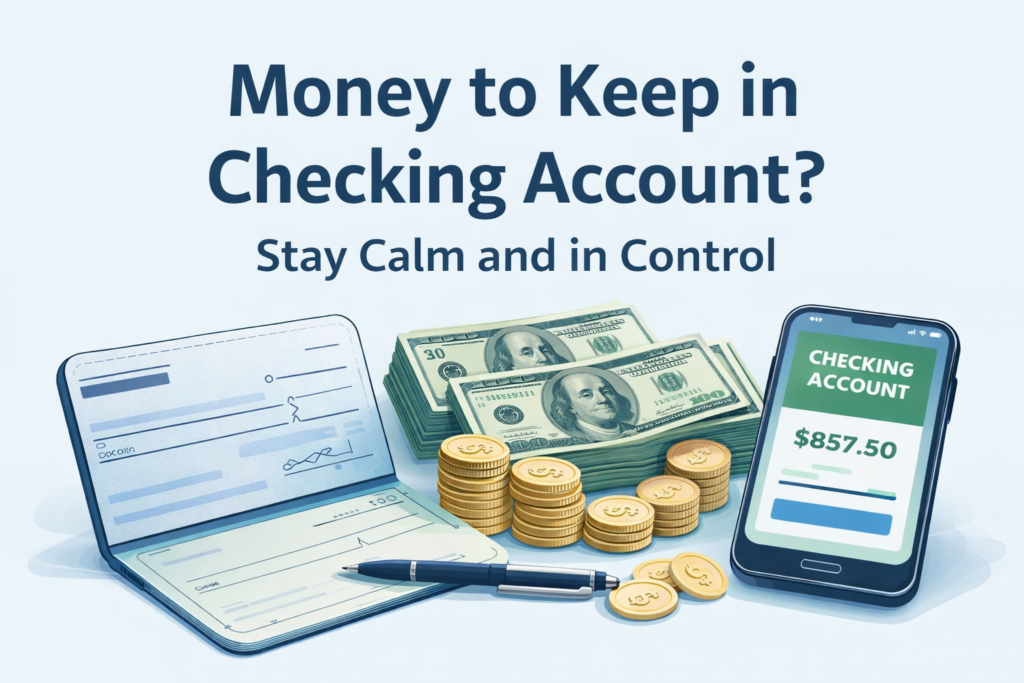
A weekly money check works best when your checking account has breathing room.
A weekly money check works best when your checking account has breathing room.
A weekly money check works best when your checking account has breathing room. Knowing how much money to keep in your checking account reduces second-guessing and helps money feel predictable.
How to do a weekly money check in under 15 minutes
You do not need special tools, though tools help. You do not need motivation. You need consistency.
Once a week, on the same day if possible, do the following:
Open your checking account and note the balance.
List any bills or expenses due before your next paycheck.
Subtract and see what is left.
That remaining number is your reality for the week.
If it is comfortable, you are stable. If it is thin, you slow down. If it is negative, you take protective action. A weekly money check turns vague worry into clear decisions.
Why this works better than willpower
Most money advice relies on willpower. Spend less. Save more. Be disciplined. That approach ignores human behavior. Willpower is unreliable when you are tired, stressed, or overwhelmed.
A weekly money check replaces willpower with structure. You do not decide every day how careful to be. You decide once a week. The decision holds until the next check.
This is how adults manage complex responsibilities in other areas of life. They use systems, not constant effort.
Weekly money check in real life
Imagine two people earning the same income.
The first person does not do a weekly money check. They feel anxious most of the time. Some weeks they overspend. Some weeks they freeze. They never feel confident.
The second person does a weekly money check every Sunday night. They know when to relax and when to pull back. They feel calmer even when money is tight because nothing is a surprise.
The difference is not income. It is clarity.
What happens when you skip a weekly money check
When you skip your weekly money check, your brain fills the gap. It starts guessing. Guessing feels like anxiety. Anxiety leads to avoidance or impulsive spending. Avoidance creates bigger problems later.
This is why people feel “bad with money” even when they are not. They are operating without feedback.
A weekly money check is feedback. Simple, honest, and non-judgmental.
Using a tool to make the weekly money check easier
You can do a weekly money check on paper, in your notes app, or in your head. But tools reduce friction. They remove decision fatigue and help you stay consistent when life gets busy.
This is why I created a simple system that turns a weekly money check into a repeatable habit instead of a mental burden.
If you want something that helps you stay consistent without turning money into a full-time job, you can use Daily Life Financial Planner – Complete Financial Management Bundle. It is a tool that helps people stay consistent when life gets busy.
How this connects to paycheck timing
One reason a weekly money check is so powerful is that it respects timing. Paycheck timing is one of the biggest hidden causes of money stress.
If you want to understand that better, read this related post: One Weekly Money Check. It explains how timing, not discipline, is often the real issue.
Weekly money check is not about perfection
You will miss weeks. Life happens. That does not break the system.
A weekly money check works because it is forgiving. You do not catch up. You do not punish yourself. You simply resume.
This attitude is critical. Shame destroys consistency. Calm restores it.
Why this matters long term
Over time, a weekly money check does more than manage cash. It builds trust with yourself. You stop feeling out of control. You stop fearing your bank account.
Money becomes information, not a threat.
That change affects relationships, work performance, and mental health. It is quiet, but it is profound.
Final thoughts on the weekly money check
A weekly money check is one of the simplest financial habits you can adopt. It does not promise wealth. It promises clarity.
Clarity is what most people are missing.
If money has felt heavy, confusing, or emotionally draining, try one thing. Pick a day. Sit down for ten minutes. Do a weekly money check.
You may be surprised how much lighter money feels when you stop guessing and start knowing.

Frequently Asked Questions
How often should I do this money check?
Once a week is enough. Doing it more often usually increases anxiety instead of reducing it. The goal is to create a predictable rhythm where money has a place in your life, not something you constantly think about.
What if my numbers look bad when I check?
That does not mean you failed. It means you caught the situation early. Seeing reality clearly gives you more control than avoiding it. Small adjustments made early are far easier than panic decisions made later.
Do I need to track every expense for this to work?
No. This system works specifically because it avoids micromanaging. You are not trying to control every dollar. You are simply understanding your current position and what is coming next.
Is this better than traditional budgeting?
It is different. Budgets focus on planning the future. This focuses on understanding the present. Many people find that clarity about today naturally leads to better decisions tomorrow without rigid rules.
What if my income or expenses change every week?
This approach is especially helpful for irregular income or fluctuating expenses. Weekly check-ins adapt to real life instead of forcing life to fit a fixed plan.
How long does it take each week?
Most people finish in 10 to 15 minutes. Over time, it often becomes even faster as the process feels familiar and calm.
What if I miss a week?
Nothing breaks. You simply continue the next week. There is no catching up and no penalty. Consistency over time matters more than perfection.
Can this help with money anxiety?
Many people find that knowing where they stand reduces background stress. When money becomes information instead of a mystery, it stops dominating your thoughts.
Do I need a tool or app to do this?
No. You can do it with a notebook, a notes app, or a simple spreadsheet. Some people choose to use tools to reduce friction, but the habit itself matters more than the format.
Is this meant to replace financial planning?
No. This is a grounding practice, not a full financial strategy. It works best as a foundation that supports better long-term decisions rather than replacing them.


Pingback: Bills Before Payday: 7 Reasons They Create Anxiety Even When Income Is Enough
Pingback: 7 Reasons Money Stress Midweek Feels Worse Than It Should
Pingback: Budgeting Between Paychecks: 7 Simple Ways to Stop Feeling Broke
Pingback: Why Money Feels Tight: 7 Real Reasons Americans Feel Stuck Financially
Pingback: One Weekly Money Check: 7 Steps to Reduce Financial Anxiety