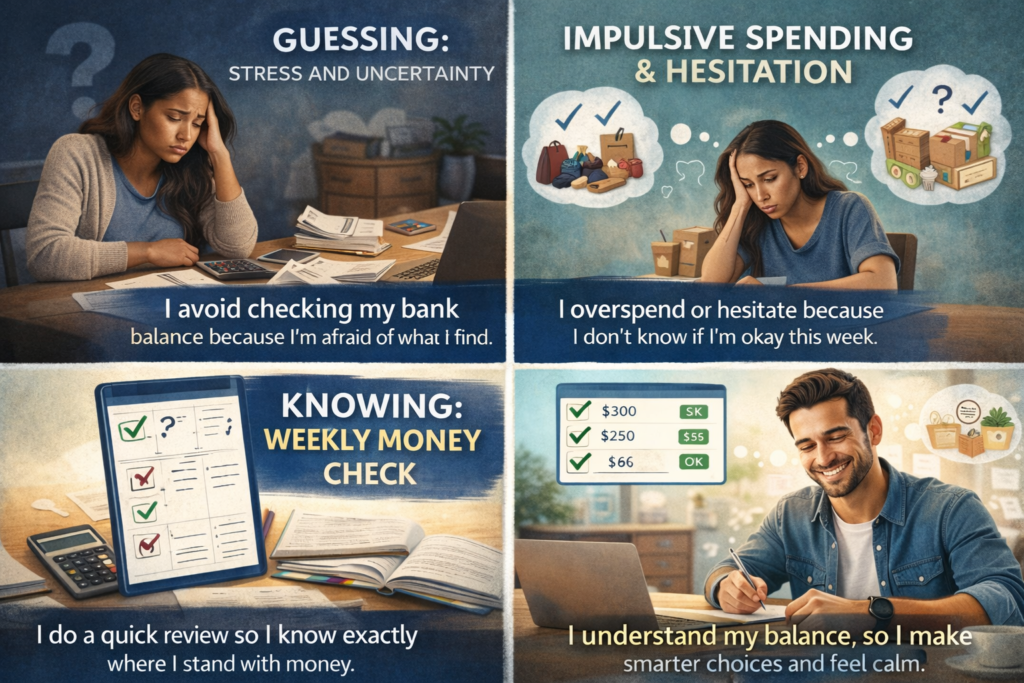
Knowing your money each week creates a very different emotional experience than guessing. Most financial stress does not come from numbers being bad. It comes from uncertainty. It comes from not knowing where you stand and being forced to imagine the outcome instead.
Guessing keeps money vague and threatening. Knowing turns money into information. That emotional shift is subtle, but it changes how your entire week feels.
By the end of this article, you will understand why guessing creates anxiety, why knowing creates calm, and how a simple weekly habit can quietly change your relationship with money without stricter budgeting or constant tracking.
What guessing does to your nervous system
When you guess about money, your brain fills in missing information on its own. It rarely fills it in optimistically. The mind assumes risk because that is how humans stay safe.
Guessing turns neutral situations into emotional ones. A normal grocery run feels dangerous. A routine subscription charge feels like a threat. You start checking balances repeatedly, not because you are careless, but because you are searching for reassurance.
Without clear reference points, money becomes something your body reacts to instead of something your mind understands.
Why knowing feels calmer even when nothing changes
Knowing your money each week does not magically increase income or eliminate expenses. What it changes is certainty.
When you know where you stand, your nervous system relaxes. Decisions feel lighter. You stop rehearsing worst-case scenarios because you no longer need to imagine them.
Even when money is tight, knowing creates stability. Tight with clarity feels manageable. Tight with uncertainty feels frightening.
The weekly gap where anxiety lives
Most financial anxiety lives in the space between paydays. Expenses clear early. Paychecks arrive later. The math may work by the end of the month, but the middle of the week feels fragile.
This is why many people experience money stress midweek. The stress is not caused by spending mistakes. It is caused by not knowing whether the week is still safe.
Knowing your money each week closes that gap. Guessing leaves it open.
The difference between monitoring and understanding
Many people monitor money constantly without understanding it. They check balances, glance at apps, and scroll transaction lists.
Monitoring without context increases anxiety. Understanding reduces it.
Knowing your money each week means understanding what the balance actually represents, what is coming next, and what flexibility exists. That clarity changes how numbers feel emotionally.
Why guessing increases emotional spending
When people guess, spending decisions swing to extremes. Some overspend because they assume things are already bad. Others underspend because they fear making things worse.
Both reactions come from missing information.
Knowing your money each week anchors decisions in reality. You stop reacting emotionally and start responding deliberately.
A real-life moment most people recognize
Someone hesitates over a small purchase on Wednesday afternoon. The amount is reasonable. The income is stable. The hesitation comes from not knowing whether the week is still okay. When they later review their money, they realize the fear had nothing to do with the purchase itself.
Why the brain prefers weekly certainty
Human brains handle complexity better in short cycles. Weekly timeframes feel concrete. Monthly projections feel abstract.
This is why a weekly money check works so well. It gives the brain a reliable rhythm of reassurance.
Knowing your money each week trains the mind to expect clarity instead of surprise.
What the data quietly supports
According to the Federal Reserve, many adults report feeling financially anxious even when they are meeting basic obligations. This suggests that emotional security depends as much on certainty as on income.
Source: Federal Reserve – Economic Well-Being of U.S. Households
How knowing your money each week changes behavior naturally
When people know where they stand, behavior adjusts without force. Spending slows when it needs to. Flexibility appears when it exists.
No rules are required. No self-punishment is needed.
Knowing your money each week removes the emotional fog that drives reactive behavior.
The role of a simple system
Knowing does not require complexity. It requires consistency.
One calm review each week is enough to shift money from background anxiety into manageable information.
A tool that supports weekly knowing
Some people find it easier to maintain weekly clarity when everything lives in one place. The Daily Life Financial Planner – Complete Financial Management Bundle is designed to support calm weekly check-ins without turning money into a daily mental task.
It is not a budgeting system. It exists to reduce uncertainty.
Why guessing feels heavier over time
Guessing accumulates stress. Each unanswered question adds weight.
People often assume money anxiety means something is wrong. Often, it simply means clarity has been delayed too long.
Knowing interrupts that accumulation.
The quiet confidence that comes from knowing
Confidence does not come from perfect numbers. It comes from familiarity.
When you know your money each week, nothing feels hidden. There is nothing to avoid. That transparency builds trust with yourself.
Over time, the act of checking stops feeling emotional and starts feeling neutral. That neutrality is peace.
Final thoughts on guessing versus knowing
Knowing your money each week does not eliminate challenges. It eliminates fear.
Guessing asks your mind to imagine danger. Knowing gives it facts.
That emotional difference is small in action, but profound in impact.
Frequently Asked Questions
Why does guessing about money increase stress?
Guessing creates uncertainty. When you do not know where you stand financially, the brain fills gaps with worst-case assumptions, which increases anxiety even if the numbers are actually fine.
How is knowing your money different from budgeting?
Knowing your money focuses on awareness, not restriction. It helps you understand your current position without forcing strict rules or constant tracking.
Does checking money weekly really reduce anxiety?
Yes. A weekly check creates predictable reassurance. When reassurance happens regularly, fear does not have time to build.
How long should a weekly money check take?
Most people complete a calm weekly review in ten to fifteen minutes once the habit becomes familiar.
Is financial fear a sign of poor money management?
No. Financial fear is usually caused by uncertainty and mental load, not by bad habits or lack of discipline.
Quick Poll
How do you usually feel about your money during the week?
- I mostly guess and feel unsure
- I avoid checking because it stresses me out
- I check occasionally but still feel anxious
- I know where I stand and feel calm
If you are comfortable, share your answer in the comments. Many people experience the same pattern.