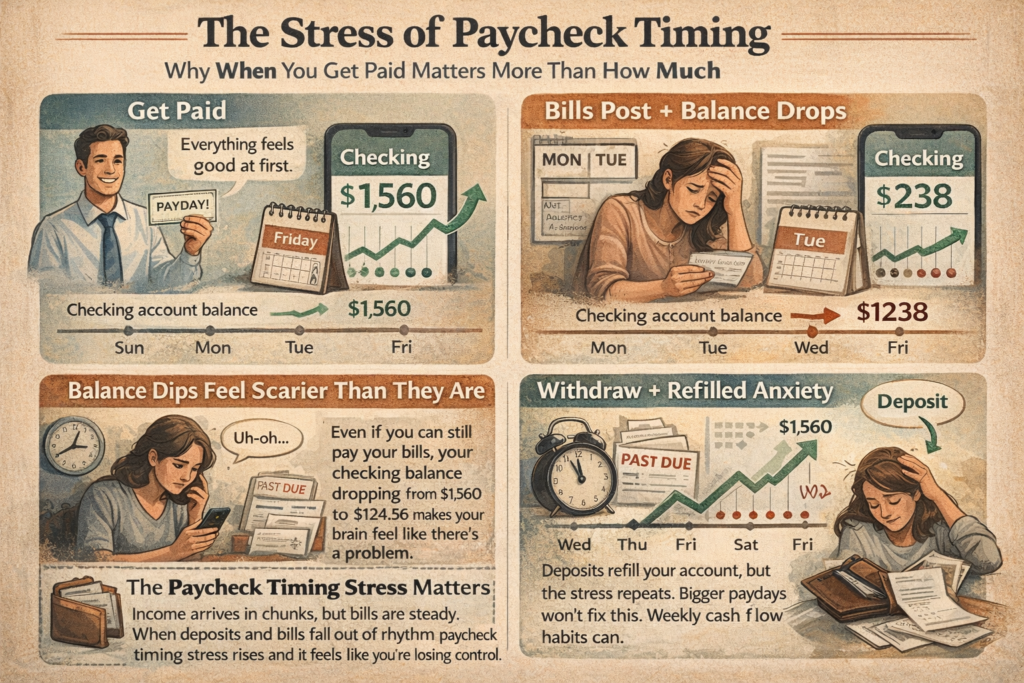
You get paid on Friday. For a moment, everything feels calm. Your checking account looks healthy. You breathe easier. Then rent clears on Monday. Insurance hits Tuesday. Groceries and gas post by Wednesday. Suddenly your balance looks thin again. Nothing went wrong. Your income did not change. But your stress did. This is paycheck timing stress, and it often shows up before any real problem exists.
Many people believe that earning more money would remove this tension. But paycheck timing stress can affect someone making $45,000 a year or $120,000 a year. The issue is not always the total amount you earn. It is when the money arrives and when it leaves. When those two rhythms do not match, your checking account dips in the middle, and your brain reads that dip as danger.
This is not a discipline problem. It is not laziness. It is cash flow rhythm. When deposits and bills are out of sync, your balance rises and falls sharply. Even if the monthly math works, paycheck timing stress creates emotional swings throughout the month. Your body reacts to what it sees in the moment, not what your spreadsheet promises later.
If your money feels tight midweek even though your income covers your bills, you are not failing. You are experiencing paycheck timing stress created by mismatched cash flow rhythm.
By the end of this article, you will understand why paycheck timing stress matters more than salary size and how to reduce that tension with small weekly awareness shifts.
Why Income Alone Does Not Solve This
It is easy to assume that a higher paycheck would fix everything. But many households with stable salaries still feel anxious midweek. Paycheck timing stress appears when large bills clear before the next deposit arrives. The visible drop feels threatening even if another paycheck is already scheduled.
This emotional reaction connects closely with The Psychological Difference Between $100 and $500 in Your Checking Account. Your brain reacts to the visible balance. If it looks low, stress rises. That reaction happens regardless of total annual income.
U.S. Money Insight
According to the Bureau of Labor Statistics, the majority of U.S. workers are paid biweekly or semimonthly rather than daily or weekly. That means income arrives in chunks, not evenly across the month. When expenses are steady but deposits are staggered, paycheck timing stress becomes common.
Cash-Flow Timing Insight
Housing costs make up roughly 34% of the average household budget in the United States according to federal labor data. When one large payment leaves at once, your checking account temporarily shrinks. That sharp drop intensifies paycheck timing stress even if income remains steady.
The Timing Gap Most Budgets Ignore
Most budgets are monthly. They tell you what you will spend and what you will earn. But paycheck timing stress lives in the weekly gaps between those numbers. If your rent is due on the first and your paycheck arrives on the fifth, your account may dip low for several days.
This pattern is explored further in The Hidden Stress of Living Between Paychecks That Budgets Ignore. The monthly math may be fine. The weekly rhythm may not. That mismatch creates emotional pressure.
When Stress Peaks
Stress often peaks midweek. Weekend spending posts first. Bills clear early. The next deposit feels far away. This is why Why Money Stress Peaks in the Middle of the Week resonates with so many readers. The visible dip is strongest before the refill.
Paycheck timing stress is not about irresponsibility. It is about seeing a lower number than your brain feels comfortable with. That moment creates tension.
Why Traditional Budgeting Fails Emotionally
Traditional budgeting focuses on totals. It does not always focus on timing. You may know your income covers your expenses, but paycheck timing stress still appears when the balance drops temporarily.
This is why Paycheck Timing Budgeting and Why Money Feels Tight emphasizes rhythm awareness. Understanding when money enters and leaves your account reduces emotional shock.
Buffers, Visibility, and Reassurance
A small checking cushion can soften paycheck timing stress dramatically. When your balance never falls below a certain comfort line, midweek dips feel less threatening.
This idea connects with How a Powerful Checking Account Cushion Changes Daily Spending Decisions. Even a few hundred dollars of visible margin changes behavior and mood.
The Avoidance Loop
When paycheck timing stress rises, some people stop checking their accounts. Avoidance feels safer than seeing a low number. But uncertainty often increases anxiety.
This pattern is explained in Why Skipping Your Weekly Money Check Makes Money Feel Scarier Than It Is. Visibility reduces fear. Avoidance feeds it.
Daniel earns a steady salary and pays bills automatically. Yet every month around the 12th, his checking balance drops below $300. He feels tense buying groceries. After mapping his deposit dates and building a $500 cushion, the numbers did not change much. His stress did. Paycheck timing stress eased once he understood his rhythm.
Weekly Reassurance vs Monthly Planning
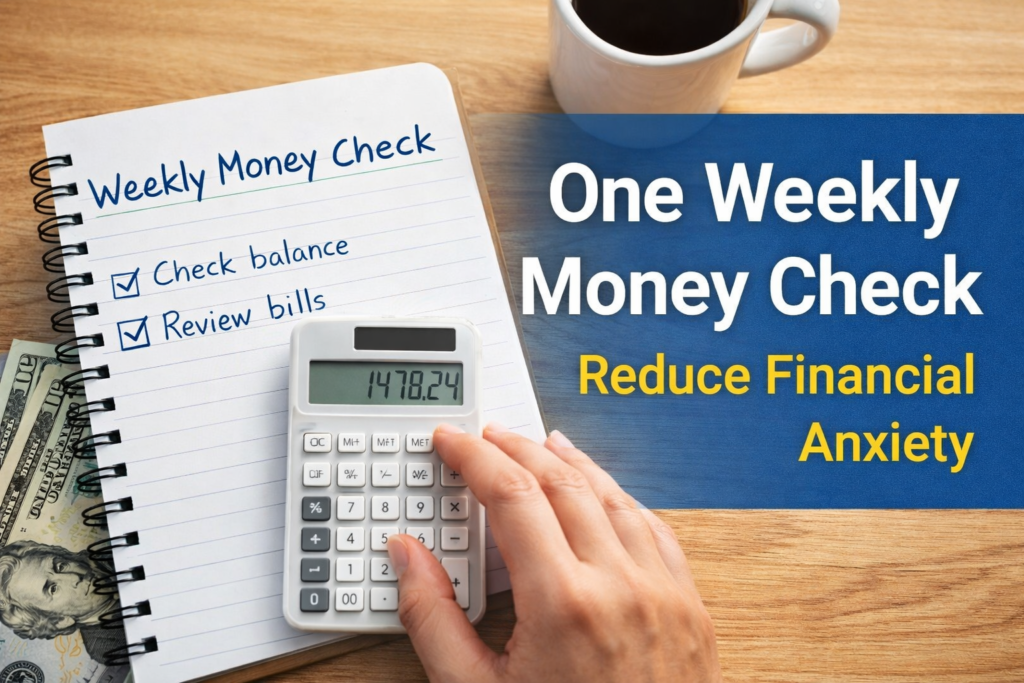
Monthly planning provides direction. Weekly reassurance provides calm. A short weekly review helps you see upcoming deposits and expenses clearly. When you understand the timing, paycheck timing stress becomes predictable instead of alarming.
If staying consistent feels hard when life gets busy, the Daily Life Financial Planner – Complete Financial Management Bundle can help. It is a tool that helps people stay consistent when life gets busy and track deposit timing, bills, and checking cushions clearly.
Frequently Asked Questions
Is paycheck timing stress common?
Yes. Many workers are paid biweekly or semimonthly, which naturally creates uneven cash flow patterns.
Would earning more fix it?
More income helps, but timing mismatches can still create midmonth dips.
What reduces paycheck timing stress?
Building a small cushion and reviewing your cash flow weekly can reduce anxiety significantly.
Quick Reflection
- When does your balance usually feel lowest?
- Do your deposit dates align with bill due dates?
- How could a small cushion reduce your paycheck timing stress?
Final Thoughts
Why paycheck timing matters more than how much you earn comes down to rhythm. Paycheck timing stress grows when deposits and bills move out of sync. With weekly visibility, small buffers, and awareness of timing, your money can feel steady even before your income increases.