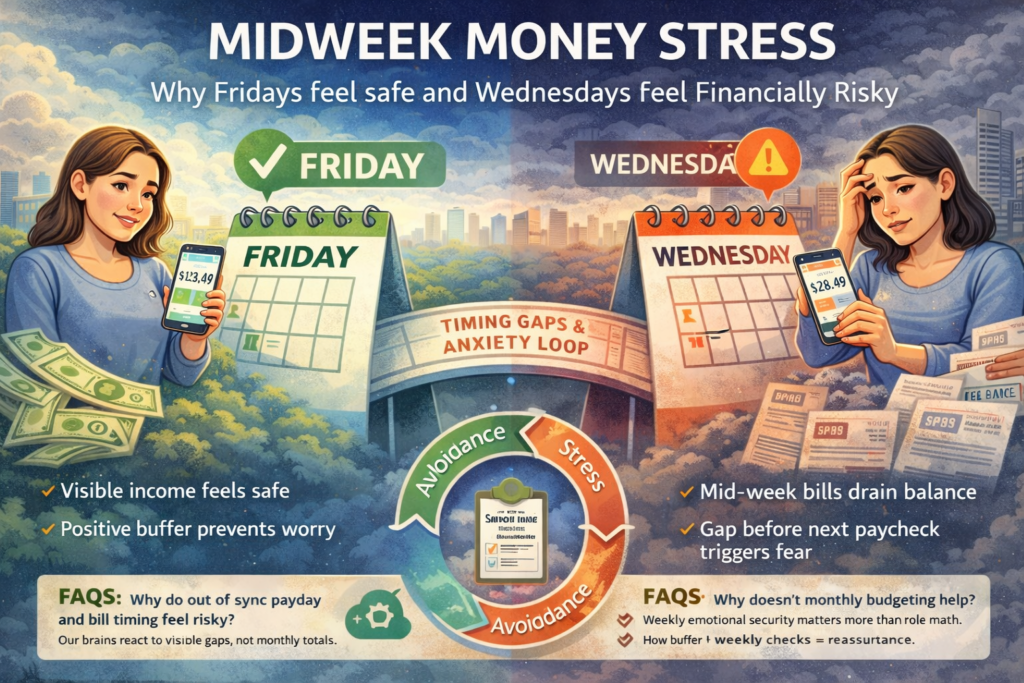
Midweek money stress is something many Americans feel but rarely talk about openly. Nothing dramatic has happened. No emergency alert has appeared. No overdraft notification has arrived. And yet, by Wednesday afternoon, there is a quiet tightness in the chest when opening a banking app. The week suddenly feels heavier than it did just a few days earlier. Friday felt calm and stable. Wednesday feels uncertain and exposed.
This emotional shift is not about irresponsibility or poor planning. It is not a discipline issue or a budgeting failure. It is a timing issue. When money leaves earlier in the week and reassurance from the next paycheck has not yet arrived, the brain reacts to that gap. Midweek money stress appears before anything technically goes wrong because the nervous system responds to visibility, not long-term math.
In this article, you will understand why Fridays feel emotionally secure, why Wednesdays feel financially fragile, and how small weekly systems reduce midweek money stress without stricter budgeting, guilt, or constant monitoring.
If you have ever felt completely fine on Friday but uneasy by Wednesday without any major change in income, you are not alone. That shift is tied to timing and visibility, not failure.
By the end of this article, you will see how paycheck timing shapes emotional safety, why midweek money stress follows a predictable rhythm, and how simple weekly reassurance restores calm.
Why income alone does not prevent midweek tension
Many people assume that steady income should eliminate anxiety. If rent is covered, utilities are scheduled, and groceries are affordable, there should be nothing to worry about. Yet midweek money stress still shows up. The reason is that income arrives in moments, while expenses flow continuously throughout the week. The brain reacts to what it sees right now, not what is scheduled to arrive in two days.
Friday often feels safe because it follows reassurance. A paycheck may have just cleared. The balance looks healthy. Bills have not yet clustered. Emotional safety increases because visible margin is high. By Wednesday, several transactions have posted. Subscriptions clear. Groceries and fuel are paid. The visible number drops. Even if the plan still works, the margin looks thinner.
This pattern mirrors what happens in how bills before payday create anxiety even when income is enough. The stress is not caused by totals. It is caused by timing gaps that temporarily shrink visible safety.
U.S. Money Stress Insight
According to the American Psychological Association, money remains one of the top sources of stress for U.S. adults, even among households with steady income. Short-term cash-flow uncertainty often drives that stress more than long-term financial standing.
How timing gaps create emotional risk
Midweek money stress grows during the gap between outgoing expenses and incoming reassurance. The mind does not calculate monthly totals in those moments. It scans for immediate safety. When the visible balance declines and the next paycheck feels distant, the nervous system shifts into caution mode. That shift can feel like danger even when nothing is technically wrong.
This emotional response connects closely to paycheck timing budgeting and why money feels tight. When money moves unevenly across the calendar, perception changes. The same income can feel abundant on Friday and fragile on Wednesday purely because of where you are in the cycle.
Understanding this rhythm reduces self-blame. Midweek money stress is predictable. Predictable patterns can be managed without shame.
Why Wednesdays feel heavier than Fridays
Fridays often follow resolution. Work is ending. A paycheck may have arrived. The week’s major expenses have not yet cleared. Emotionally, Friday signals completion and safety. Wednesday, by contrast, sits in the middle. Expenses have posted. There is still time before reassurance arrives. The mind interprets that middle space as uncertainty.
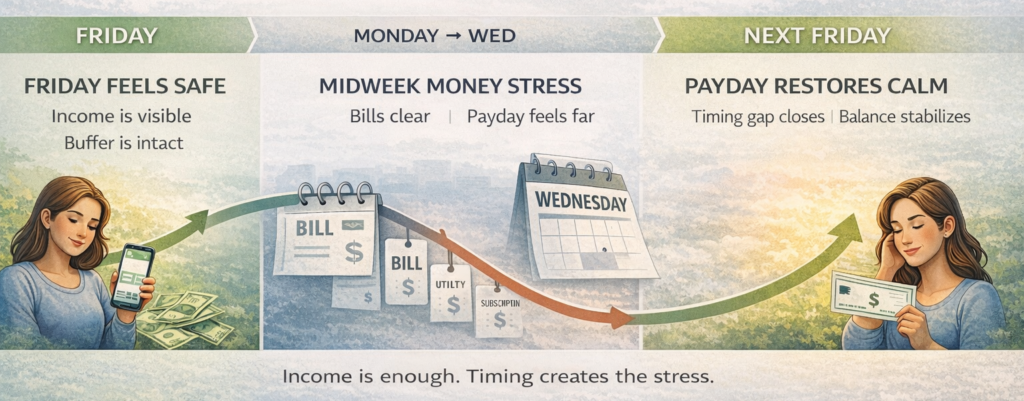
This is why so many readers relate to why money stress peaks in the middle of the week. The discomfort follows a consistent rhythm tied to calendar placement, not financial failure.
Midweek money stress feels personal, but it is structural. Once you recognize that pattern, the intensity often decreases.
The psychological effect of calendar gaps
Midweek money stress is rarely about the total amount in your account. It is about what the calendar is signaling. When Wednesday arrives and payday still feels several days away, the brain does not calmly calculate your monthly income. It reacts to visible distance. That distance between today and the next deposit creates a psychological gap, and the brain interprets gaps as risk.
Humans are wired to seek reassurance in cycles. When reassurance comes regularly, anxiety stays low. When reassurance is delayed, uncertainty grows. Midweek money stress builds during this delay. Bills have already cleared. Groceries are paid. Subscriptions have posted. But income has not yet arrived. The mind focuses on what is missing rather than what is stable.
This is why Fridays often feel safe even if nothing dramatic changed financially. The paycheck may have just landed, or it is about to. That proximity restores certainty. Wednesday, however, sits in the middle of the cycle. It is far enough from the last deposit and far enough from the next one to feel exposed.
Understanding this rhythm helps remove self-blame. Midweek money stress does not mean you are failing at budgeting. It means your brain is reacting to timing gaps. Once you see the pattern clearly, you can respond with structure instead of fear. Weekly reassurance, small buffers, and visibility shorten the emotional distance between pay cycles.
Why traditional budgeting does not calm midweek anxiety
Monthly budgets answer big-picture questions. They show whether income covers expenses over time. But they do not always calm daily emotion. Midweek money stress is rarely about the monthly total. It is about visible margin in the present moment. A perfect spreadsheet cannot override a thin-looking balance on Wednesday afternoon.
This limitation is why approaches like budgeting between paychecks focus on timing awareness instead of rigid restriction. Emotional steadiness requires real-time reassurance, not just long-term planning.
Budgeting systems that ignore timing can leave people feeling confused about why anxiety persists despite doing everything “right.”
How visibility and small buffers restore calm
A small buffer can dramatically reduce midweek money stress. When a visible cushion keeps the balance above panic territory, Wednesday no longer feels like a financial cliff. The number may dip slightly, but it does not cross into emotional danger.
This concept is explained further in 3 reasons a small checking account cushion makes money feel less scary. A buffer does not increase income. It increases emotional safety by smoothing the lowest point of the weekly cycle.
Combined with weekly visibility, buffers prevent imagination from taking over during quiet midweek moments.
The avoidance loop that midweek stress creates
When anxiety rises midweek, many people avoid checking their accounts. Avoidance feels protective. Unfortunately, it increases uncertainty. That uncertainty amplifies midweek money stress further. The cycle becomes stress, avoidance, more stress.
This pattern mirrors why skipping your weekly money check makes money feel scarier than it is. The longer visibility is delayed, the heavier the middle of the week can feel.
Interrupting that loop with a gentle check-in restores control before fear escalates.
A real-life example
Imagine someone who feels confident every Friday after payday. By Wednesday, several bills have cleared and groceries are purchased. The balance looks lower than expected. They begin second-guessing small expenses and avoid opening their banking app. When they finally look, they realize everything is manageable. The stress came from timing and guessing, not actual shortage.
Why weekly reassurance matters more than monthly planning
Midweek money stress fades when reassurance arrives consistently. A weekly money check shortens the gap between fear and clarity. Instead of waiting for payday to feel safe again, reassurance becomes scheduled and predictable.
This idea connects directly to one weekly money check that prevents financial anxiety. Regular awareness reduces emotional swings across the week.
When reassurance becomes routine, Wednesday feels steadier and Friday feels less like rescue.
A supportive tool for staying consistent
For people who want structured visibility without daily overwhelm, the Daily Life Financial Planner – Complete Financial Management Bundle provides a calm framework for weekly reviews, buffer tracking, and paycheck timing awareness.
Frequently Asked Questions
Why does money feel safer on Friday?
Friday often follows income arrival or fewer cleared expenses. The visible balance appears stronger, increasing perceived safety.
Is midweek anxiety a budgeting failure?
No. It is usually a timing mismatch between expenses and reassurance.
How can I reduce midweek money stress?
Small buffers and scheduled weekly visibility shorten the uncertainty gap and stabilize emotion.
Quick Reflection
- You feel calm after payday but tense midweek
- Balances look thinner on Wednesday
- You avoid checking when the number feels low
- You want steadier financial confidence across the week
Final thoughts
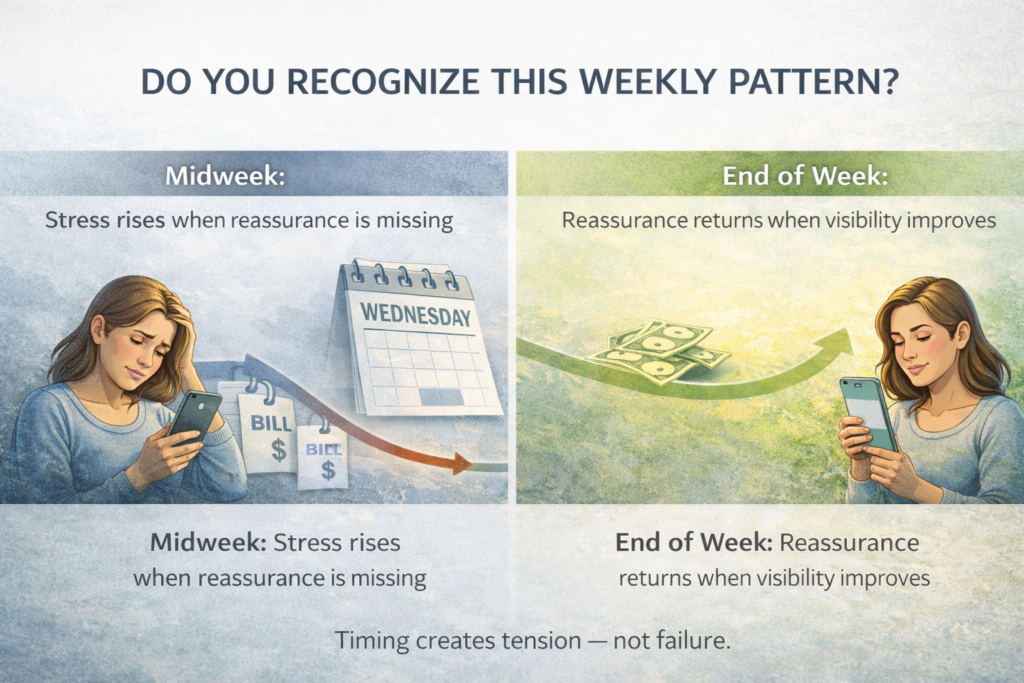
Midweek money stress does not mean you are failing. It means reassurance is arriving too late in the cycle.
When timing becomes visible and small buffers protect the lowest point of the week, Fridays stop feeling like rescue and Wednesdays stop feeling dangerous.