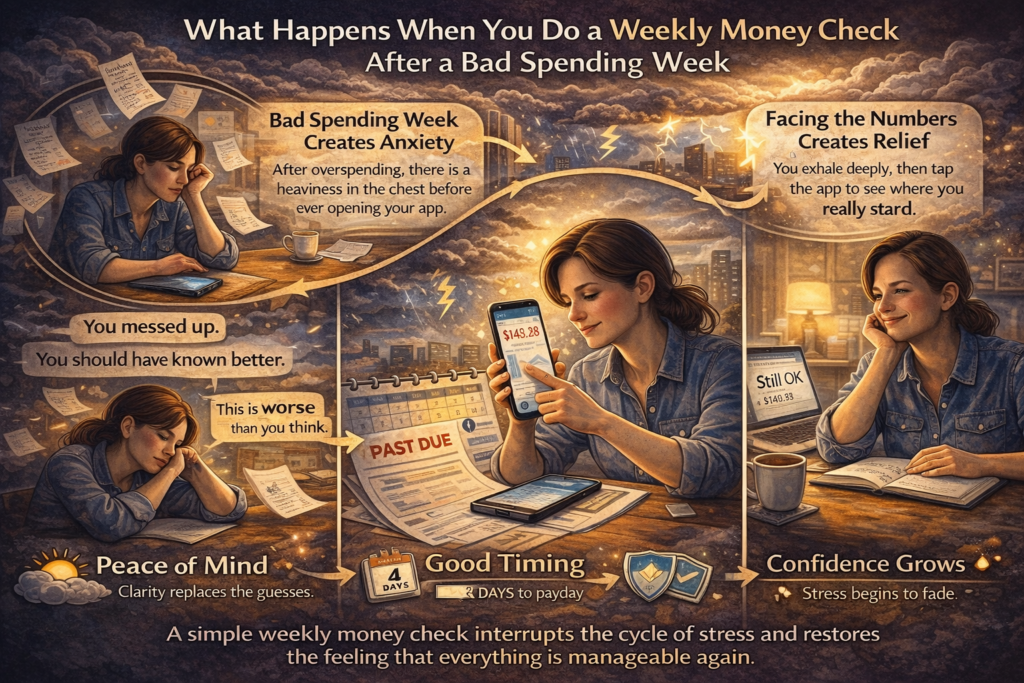
Weekly money check reset is something most people avoid after a bad spending week, not because they are irresponsible, but because they expect the numbers to confirm their worst fears. The anxiety usually starts before the banking app even opens. There is a quiet heaviness in the chest, a mental replay of every purchase, and an assumption that damage has already been done. The stress appears before facts do, which is why the experience feels so emotionally loaded.
After a week of eating out more than planned, clicking “buy now” a few extra times, or saying yes to convenience, the brain switches into threat mode. It does not calmly calculate income cycles or upcoming deposits. Instead, it imagines shortfalls, tight margins, and consequences that may not actually exist. A weekly money check reset forces that imagined story to meet reality, which is uncomfortable at first but often relieving seconds later.
Most people are surprised by what actually happens when they complete a weekly money check reset after overspending. Instead of panic escalating, clarity begins to settle in. The mind stops guessing. The nervous system gets updated information. Even if the balance is lower than preferred, certainty replaces imagination. That shift alone reduces tension in a way that avoidance never can.
If you’ve ever delayed looking at your account after a rough week, you are not weak or careless. You are responding to uncertainty. The desire to avoid is a protection reflex, not a personality flaw. Most Americans with steady income experience this at some point, especially when money already feels emotionally sensitive.
By the end of this article, you will understand why a weekly money check reset often brings relief after overspending, how awareness shifts behavior naturally, and why this habit builds trust instead of guilt.
Why income and logic don’t immediately calm the fear
After a bad spending week, many people remind themselves that their paycheck is stable or that the expenses were “one-time.” Logically, this should reduce anxiety. Emotionally, it rarely does. The brain does not calm itself with explanations alone. It looks for visible proof of safety. Until it sees where you stand, it assumes uncertainty equals risk.
A weekly money check reset works because it provides that proof. Monthly budgets and salary numbers live in abstraction. Your checking account balance feels immediate. It represents today. When spending feels out of rhythm, the brain reacts to the present moment rather than future income. This explains why even high earners can feel tense after a week that felt financially messy.
Research from the American Psychological Association consistently shows money remains a leading source of stress in the United States, even among households with stable earnings. The stress is not always about scarcity. It is often about unpredictability. A weekly money check reset reduces unpredictability by shortening the gap between action and reassurance.
How timing gaps amplify the emotional reaction
Overspending rarely feels isolated. It often overlaps with timing gaps. Expenses clear early in the week, while income still feels days away. That space between outgoing and incoming money is where fear grows. Without updated information, the mind fills that gap with assumptions. Those assumptions are usually harsher than reality.
This pattern connects directly to why money stress peaks in the middle of the week. Stress often intensifies midweek not because something catastrophic happened, but because reassurance is temporarily missing. A weekly money check reset interrupts that pattern by providing confirmation before the imagination spirals.
When you avoid checking, guessing takes over. The emotional difference between guessing and knowing is powerful. That difference is explored further in the emotional difference between guessing and knowing your money each week. Knowing, even when imperfect, almost always feels steadier than guessing.
Why traditional budgeting feels harsh after overspending
Strict budgeting systems often highlight red numbers, broken categories, and missed targets. After a bad spending week, this can feel like confirmation of failure. That emotional tone pushes people toward avoidance rather than improvement. The system feels judgmental instead of supportive.
A weekly money check reset shifts the question. Instead of asking, “Did I fail?” it asks, “Where am I right now?” That subtle shift changes the entire emotional experience. Awareness replaces evaluation. This approach aligns more closely with one weekly money check that prevents financial anxiety, where the goal is reassurance, not restriction.
When awareness comes first, behavior adjusts naturally. People tend to spend more thoughtfully after clarity, not because they were shamed, but because they feel grounded again.
How visibility and buffers restore emotional safety
Seeing your actual numbers brings the nervous system back into the present. Even if the balance is lower than ideal, clarity creates stability. A weekly money check reset transforms unknown risk into known reality. Known reality is almost always calmer than imagined disaster.
This is closely connected to why seeing a low checking account balance triggers panic even before bills hit. The panic is usually about perceived danger, not actual insolvency. Visibility corrects perception. It gives your brain context.
Buffers serve a similar emotional role. Even a small cushion changes how numbers feel. It creates space between today’s balance and zero. That space communicates safety to the brain in a way that spreadsheets cannot.
The avoidance loop that keeps anxiety alive
Stress often leads to avoidance. Avoidance increases uncertainty. Increased uncertainty intensifies stress. This loop can continue for weeks if not interrupted. A weekly money check reset gently breaks that cycle by introducing consistent exposure to reality in a controlled way.
This is why skipping your weekly money check makes money feel scarier than it is. The longer you delay, the larger the imagined problem becomes. The act of looking, even briefly, reduces the size of the unknown.
Consistency matters more than perfection. The habit itself builds emotional resilience over time.
A short real-life example
Someone has a week filled with small conveniences: extra takeout, a spontaneous online order, and a few subscriptions they forgot about. By Friday, they feel uneasy and assume the situation is worse than it is. They delay opening their app. When they finally complete a weekly money check reset, they realize the impact is manageable. The balance is lower, but stable. The stress came from imagination, not catastrophe.
Why weekly reassurance restores calm faster than monthly planning
Monthly planning answers long-term questions. Weekly reassurance answers emotional ones. After a rough week, the brain is not worried about retirement projections. It wants to know if today is okay. A weekly money check reset delivers that answer quickly and directly.
Over time, this pattern builds trust. Instead of associating money with fear, you begin associating it with clarity. That shift changes how future spending weeks feel because you know you will look and recalibrate instead of spiraling.
A supportive structure for staying consistent
Understanding this concept is one thing. Practicing it consistently is another. The Daily Life Financial Planner – Complete Financial Management Bundle provides a calm, structured space for a weekly money check reset without turning money into a daily obsession. It supports visibility, reflection, and steady reassurance.
Frequently Asked Questions
Will checking after overspending make me feel worse?
Most people feel relief once uncertainty is replaced with facts. Even imperfect numbers feel steadier than imagined outcomes.
Is a weekly check the same as budgeting?
No. A weekly money check reset focuses on awareness and reassurance rather than strict categories or punishment.
What if the numbers are lower than expected?
Knowing allows adjustment. Guessing keeps anxiety active and unresolved.
Quick Reflection
- You feel tense before opening your banking app
- Money stress peaks midweek
- You avoid checking after overspending
- You feel calmer once you finally look
Final thoughts
A weekly money check reset after a bad spending week is not about discipline. It is about replacing uncertainty with clarity. When reassurance becomes routine, fear loses intensity. Money begins to feel manageable again because you consistently choose awareness over avoidance.