One weekly money check is one of the simplest habits you can build to reduce financial anxiety, especially if money feels heavy even when you are doing everything “right.” It does not require a budget overhaul, a new app, or perfect discipline. It only requires a small, intentional pause once a week to understand where your money actually stands.
Many people feel stressed about money even when they are paying their bills on time. That stress usually comes from uncertainty, not from a lack of income. A one weekly money check replaces uncertainty with clarity, and clarity is what creates calm.
When you know what is happening with your money once a week, money stops following you around all day. You stop replaying numbers in your head. You stop bracing for surprises. You start trusting yourself again.
Why Financial Anxiety Builds When Money Feels Unclear
Financial anxiety rarely appears suddenly. It builds quietly through avoidance. Missed logins. Ignored notifications. Delayed balance checks. Each small delay adds a little more tension to your body.
Without a one weekly money check, your brain fills in the gaps with worst-case assumptions. Even small expenses start to feel risky because you are guessing instead of knowing. Guessing creates fear, and fear makes money feel bigger than it is.
This stress often peaks between paychecks. Income might be steady, but timing creates pressure. Bills cluster. Groceries cannot wait. If you want to understand this better, this guide on paycheck timing and why money feels tight explains why anxiety shows up even when income is technically enough.
When money feels unclear, your nervous system treats it like a threat. That is why learning one weekly money check is as much about emotional safety as it is about numbers.
What a One Weekly Money Check Really Is
A one weekly money check is a short review of your current financial reality. It usually takes ten to fifteen minutes. It does not involve tracking every expense or categorizing purchases.
The purpose of a one weekly money check is to answer one simple question: am I okay for the next stretch of time? That question alone reduces panic.
This habit creates rhythm. Instead of reacting daily or avoiding money completely, you check once a week and make small, gentle adjustments. Small adjustments prevent big problems.
Over time, this habit teaches your brain that money is something you look at calmly, not something you avoid or obsess over.
When to Do Your One Weekly Money Check
The best time for a one weekly money check is the same time every week. Consistency matters more than the exact day or hour.
Many people choose Sunday evenings because it creates a mental reset before the week begins. Others prefer Monday mornings or the day after payday. The right choice is the one you will actually keep.
Once this becomes routine, your nervous system begins to relax. You stop wondering when to check your money because you already know there is a safe, predictable time for it.
This predictability is one of the hidden benefits of a one weekly money check. Predictability creates trust, and trust reduces anxiety.
This idea is part of a broader system explained in a weekly money check system that makes money feel manageable , which shows how a simple weekly habit can reduce money stress without budgeting overload.
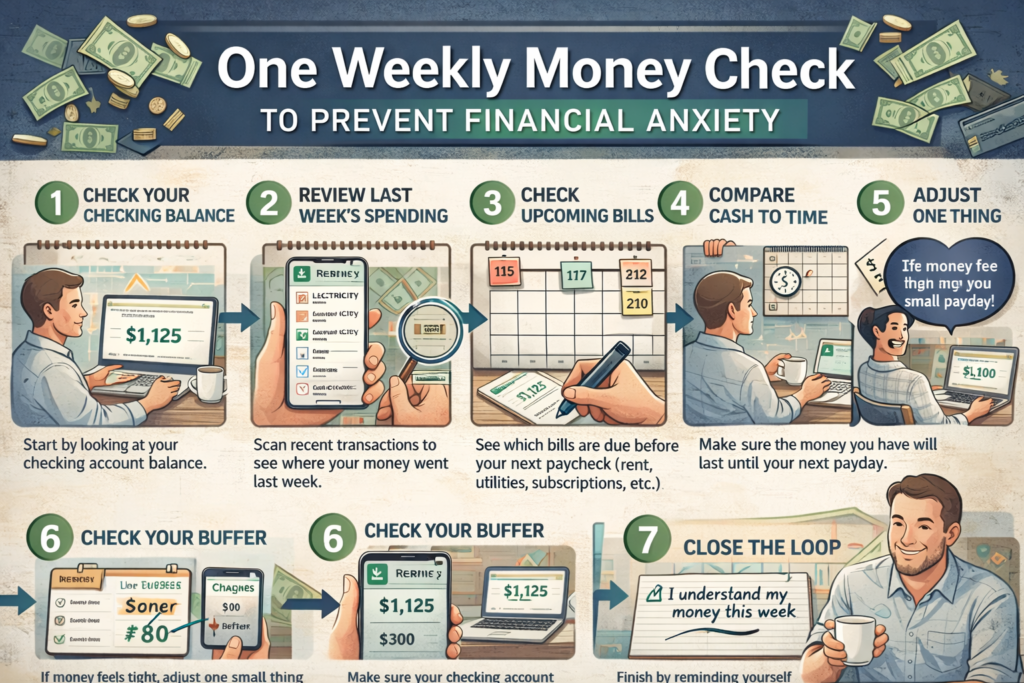
The 7-Step One Weekly Money Check
1. Look at Your Checking Account Balance
Start with your checking account. This is where daily life happens. Rent, groceries, gas, subscriptions, and everyday spending all flow through this account.
Look at the number without judgment. Awareness is the goal of a one weekly money check, not emotion. The number is information, not a verdict.
2. Review the Last Week of Spending
Scan recent transactions from the past seven days. You are not auditing yourself or assigning blame. You are noticing patterns.
This step often explains why money feels tighter than expected. Small, frequent expenses add up quietly, and seeing them once a week keeps them from becoming overwhelming.
3. Check What Bills Are Coming Next
Look at what will post before your next paycheck. Rent, utilities, subscriptions, insurance, groceries.
Financial anxiety often comes from forgetting what is about to happen. When you know what is coming, your body relaxes.
4. Compare Cash to Time
Ask one grounding question: is the money I have enough for the time ahead?
This is where timing matters more than totals. Many people feel anxious because their cash and timing are misaligned, not because they lack money.
5. Make One Small Adjustment
If something feels tight, adjust one thing. Delay a purchase. Move a grocery trip. Transfer a small amount.
A one weekly money check works because it focuses on small corrections instead of dramatic changes. Small corrections keep money calm.
6. Check Your Buffer or Cushion
If you keep a buffer in your checking account, confirm that it is still intact. This buffer protects you from timing issues and surprise charges.
This step pairs naturally with the checking account buffer that helps you avoid overdraft fees, which explains how small cushions prevent big stress.
7. Close the Loop
End your one weekly money check by reminding yourself that you are aware and in control. This mental closure is just as important as the numbers.
Closing the loop teaches your brain that money does not need to stay open and unresolved all week.
Why Weekly Checks Work Better Than Daily Tracking
Daily tracking increases anxiety for many people. Weekly checking reduces it.
Daily tracking often creates pressure because it turns money into something you feel judged by every day. A one weekly money check works better because it gives you space to live your life without constantly watching numbers move. Instead of reacting emotionally to every small expense, you zoom out and look at patterns. This weekly rhythm keeps you informed without overwhelming you, which is why it reduces financial anxiety instead of adding to it.
When you check daily, every fluctuation feels urgent. When you check weekly, patterns become visible and emotions calm down.
A one weekly money check gives you distance without avoidance. You stay informed without staying tense.
The Emotional Shift That Happens After a Few Weeks
After a few weeks of a one weekly money check, something noticeable changes. You stop being surprised by money.
One weekly money check works because it replaces constant worry with a small, predictable habit. Instead of thinking about money every single day, you give yourself one calm moment each week to look at your checking account, upcoming bills, and recent spending. This single weekly money check creates clarity without overwhelm and helps your mind relax around money.
Over time, your brain learns that money is being handled. You stop reacting emotionally to balances and start trusting your system. That is why financial anxiety slowly fades. The one weekly money check shifts money from something that feels stressful into something that feels organized, steady, and under control.
You open your bank app without tension. Bills feel expected instead of threatening. Spending decisions feel clearer.
This emotional shift is the real benefit. Calm is the outcome, not perfection.
Many people report sleeping better and thinking about money less once this habit becomes routine.
How This Fits Into a Simple Money System
The one weekly money check works best inside a simple money system. Instead of managing money every day, you create structure and trust the system between check-ins.
This approach reduces decision fatigue and keeps money from dominating your thoughts.
If you want help turning this habit into a repeatable routine, the Daily Life Financial Planner – Complete Financial Management Bundle is designed to support simple systems that reduce stress and keep money predictable when life gets busy.
Common Mistakes to Avoid
Do not turn your one weekly money check into a budgeting marathon. Keep it short.
Do not use it to shame yourself. Shame breaks systems.
Do not skip weeks when money feels uncomfortable. Those weeks matter most.
If You Miss a Week
Missing a week does not mean failure. Simply restart.
Missing a week does not mean you failed or lost control. One weekly money check is meant to support real life, not punish you for being busy or tired. When you skip a week, simply return to your next scheduled check without trying to fix everything at once. This flexibility is what keeps the habit sustainable long term and prevents financial anxiety from creeping back in through guilt or perfectionism.
The power of a one weekly money check comes from repetition, not perfection.
Why This Habit Prevents Financial Anxiety Long Term
Financial anxiety thrives on uncertainty and delay.
A one weekly money check replaces both with awareness and rhythm.
Over time, money becomes predictable. Predictability creates safety.
This safety allows you to make better decisions without fear.
Final Thoughts
You do not need to control money every day to feel calm.
You need one reliable habit that keeps you grounded.
One weekly money check is enough to turn money from a constant worry into a manageable part of life.
Frequently Asked Questions
What is a one weekly money check?
A one weekly money check is a simple habit where you review your checking account balance, recent spending, upcoming bills, and cash buffer once a week. It helps you stay aware of your money without tracking every transaction daily.
How long does a one weekly money check take?
Most people can complete a one weekly money check in 10 to 15 minutes. The goal is clarity, not perfection. You only review what matters for the next few days.
Why does a one weekly money check reduce financial anxiety?
Financial anxiety often comes from uncertainty. A one weekly money check reduces that uncertainty by showing you exactly where your money stands and what’s coming next, so there are no surprises.
When is the best day to do a one weekly money check?
The best day is usually one or two days after you get paid. This timing lets you see your real available balance and plan calmly for upcoming expenses.
Do I still need a budget if I do a one weekly money check?
You can still use a budget, but many people find that a one weekly money check works better for real life. It focuses on cash flow and awareness instead of strict rules.
What if I miss a week?
Missing one week does not break the habit. Simply restart your one weekly money check the following week. Consistency over time matters more than perfection.

Pingback: 1 Weekly Money Check That Stops Financial Stress
Pingback: Why Money Feels Tight: 7 Real Reasons Americans Feel Stuck Financially