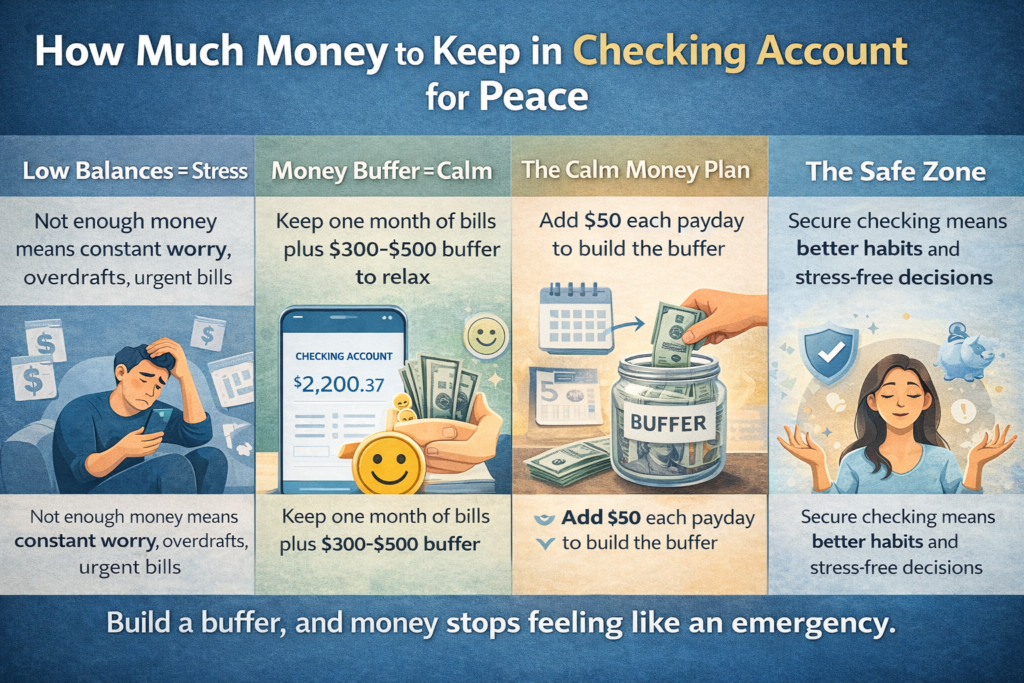
Most people are never taught how much money to keep in checking account, even though this one decision affects daily stress more than almost anything else in personal finance.
Most advice jumps straight to budgets, spreadsheets, and savings goals, but it skips how money actually feels when your checking balance gets low.
If you have ever checked your bank app before buying groceries, delayed a small purchase because payday felt far away, or felt tension when bills posted early, this guide is for you.
This article explains how much money to keep in checking account so money feels calm, not tight.
Why the Money in Your Checking Account Affects Your Stress
Your checking account is where daily life happens.
Rent, groceries, gas, subscriptions, school costs, and everyday expenses all move through it. When there is not enough money to keep in checking account, your body stays on alert.
If you want official guidance on how checking accounts work, the Consumer Financial Protection Bureau explains checking account balance basics in clear, everyday language.
You may be fine on paper, but emotionally you feel behind.
Low balances turn normal spending into mental work. Every swipe feels risky. Every bill feels urgent.
This is why choosing the right amount of money to keep in checking account matters just as much as saving or investing.
The Biggest Mistake People Make With Their Checking Account
The most common mistake is keeping only what feels necessary in the moment.
People calculate bills, subtract expenses, and aim to finish the month close to zero. That may look efficient, but it creates constant pressure.
When you keep exact amounts, there is no room for timing issues, delayed deposits, or unexpected charges.
This is when overdrafts happen. This is when stress spikes.
The goal is not precision. The goal is calm.
The Simple Rule for Money to Keep in Checking Account
A calm checking account does not need a large balance.
It needs a small, intentional buffer.
A simple rule is to keep enough money to keep in checking account to cover one month of essential bills plus a small buffer of $300 to $500.
This buffer absorbs timing issues, protects against mistakes, and gives your brain space to relax.
If your monthly essentials are $1,800, keeping $2,100 to $2,300 in checking is often enough to feel steady.
How Much Money to Keep in Checking Account Based on Your Life
The right amount of money to keep in checking account depends on how your income arrives and how your bills behave.
If you are paid weekly, you may need a smaller buffer.
If you are paid biweekly or irregularly, a larger cushion helps smooth gaps.
Parents, freelancers, and hourly workers often need more money to keep in checking account than salaried workers with predictable pay.
The goal is stability, not comparison.
Why Keeping Too Much Money in Checking Account Can Backfire
There is also a limit.
Keeping too much money to keep in checking account can blur the line between spending and saving.
Large balances invite casual spending and reduce motivation to move money into savings.
Your checking account should feel safe, not unlimited.
It is a tool, not a warehouse.
The Emotional Shift That Happens When Your Buffer Is Right
Something subtle changes when your checking balance stops hovering near zero.
You stop checking your bank app constantly.
You stop bracing for bills.
You make decisions based on needs, not fear.
Knowing you have enough money to keep in checking account creates emotional breathing room, even if your income stays the same.
How a Checking Account Buffer Prevents Overdraft Stress
A buffer is the difference between reacting and responding.
It protects you from merchant delays, forgotten subscriptions, and timing mistakes.
This is why pairing your balance with a cushion matters.
You can learn more in the checking account buffer that helps you avoid overdraft fees, which explains how small margins remove money panic.
How to Build the Right Checking Balance Without Feeling Behind
You do not need to build your ideal money to keep in checking account overnight.
Start small.
Add $50 or $100 each paycheck until the buffer exists.
Once it is there, stop growing it.
The goal is consistency, not accumulation.
Where the Rest of Your Money Should Live
After your checking account feels calm, extra money belongs elsewhere.
Savings accounts and emergency funds serve different purposes.
Checking is only for daily life.
Separating roles makes money easier to manage.
According to the Consumer Financial Protection Bureau, keeping a small cash buffer helps households avoid overdraft stress.
Why This Simple System Works in Real Life
This system works because it respects how people actually experience money.
It removes constant decision fatigue.
It reduces fear-based spending.
It turns your checking account into quiet support instead of stress.
Choosing the right money to keep in checking account is not about math. It is about peace.
Final Thoughts on Money to Keep in Checking Account
You do not need a perfect budget to feel financially steady.
You need a checking account that supports your real life.
When you choose the right amount of money to keep in checking account, money stops feeling like an emergency and starts feeling manageable.
That calm is worth more than squeezing every dollar.


Pingback: 7 Reasons Money Stress Midweek Feels Worse Than It Should
Pingback: 1 Weekly Money Check That Stops Financial Stress